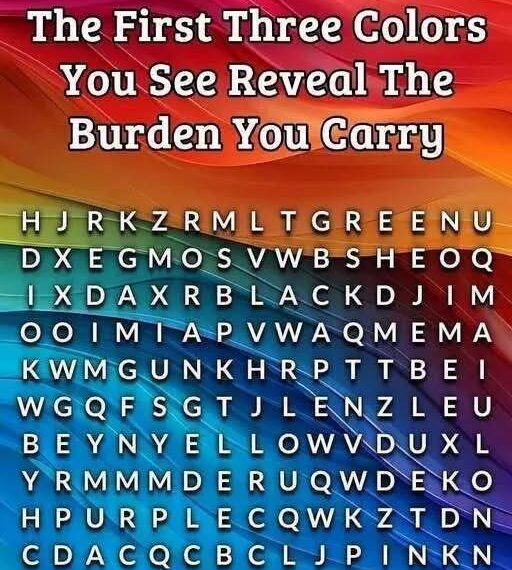
Have you ever found yourself staring at a simple puzzle or optical illusion longer than you expected? Sometimes, the images that spread across social media aren’t just entertaining—they invite us to pause, observe, and think about ourselves in a different way. One popular trend encourages people to look at a colorful word search and identify the first three colors they notice. According to the playful challenge, those colors may reveal something about the emotional burdens you carry or the strengths you rely on every day.
Of course, there is no scientific evidence that the first colors you notice can diagnose your personality or predict your future. Human perception is influenced by many factors, including attention, mood, lighting, previous experiences, and even where your eyes happen to land first. Nevertheless, exercises like this can be enjoyable tools for self-reflection, encouraging us to think about our emotions and how we respond to life’s challenges.
Rather than viewing the results as fixed truths, consider them conversation starters. The colors that catch your attention might remind you of certain memories, personal values, or qualities you admire. Sometimes, simply taking a moment to reflect can reveal insights about yourself that you hadn’t consciously recognized before.
Why Do Different People Notice Different Colors?
Our brains constantly process enormous amounts of visual information. To make sense of everything around us, they quickly identify patterns, contrasts, and familiar shapes. This process happens almost instantly, often before we’re even aware of it.
Several factors influence which colors you notice first:
- Brightness and contrast within the image.
- Your current emotional state.
- Personal memories associated with specific colors.
- Cultural meanings attached to different shades.
- Individual visual perception.
Someone who immediately spots blue may not necessarily be calmer than someone who notices red first. Instead, their attention may simply be drawn toward cooler colors, stronger contrasts, or familiar patterns.
That’s one reason why personality quizzes based on colors remain so fascinating—they encourage people to compare experiences while recognizing that everyone sees the world a little differently.
What Different Colors Traditionally Represent
Color psychology has been studied for decades in fields such as marketing, design, interior decorating, and behavioral science. While experts agree that colors can influence mood, they also emphasize that meanings vary across cultures and individuals.
Here are some of the most common symbolic associations.
Red
Red is often connected with:
- Confidence
- Determination
- Energy
- Passion
- Courage
People who feel drawn to red sometimes describe themselves as ambitious and action-oriented. Red also symbolizes strong emotions and motivation.
Blue
Blue frequently represents:
- Calmness
- Trust
- Stability
- Reflection
- Reliability