The train may seem distant, but it is still approaching.
Standing on railroad tracks is never considered safe.
Risk level: Extremely high
The Real Trick Behind the Puzzle
Most people approach the puzzle by asking:
“Which situation looks least dangerous?”
But the better question is:
“Which danger can be avoided most easily?”
This subtle difference changes everything.
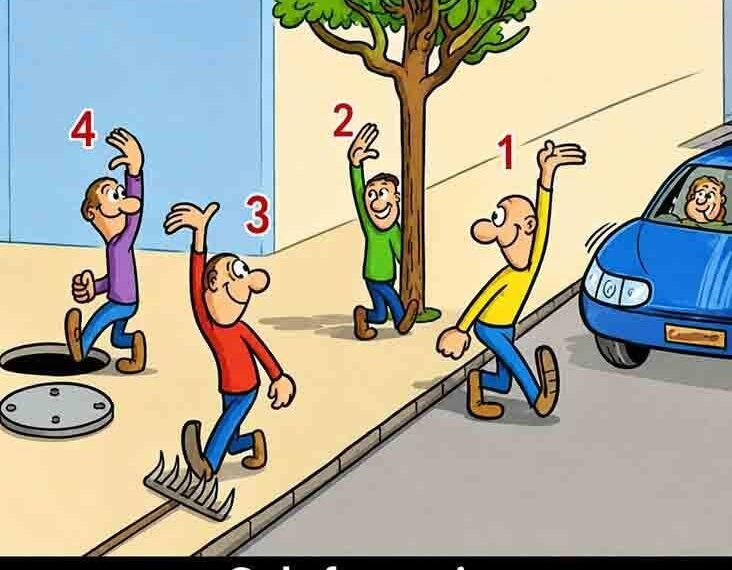
Person 1 cannot control lightning.
Person 3 is already exposed to electrical danger.
Person 4 is standing directly in the path of a train.
Person 2, however, is merely near a hazard.
The open manhole presents a risk, but the risk can be avoided with a simple decision.
That distinction is what makes this puzzle so effective.
Why So Many People Choose the Wrong Answer
Psychologists often talk about the difference between perceived risk and actual risk.
Humans tend to fear dramatic dangers while underestimating familiar ones.
For example:
- Many people fear airplane crashes more than car accidents.
- Many fear sharks more than household injuries.
- Many focus on the open manhole because it looks unusual.
The puzzle exploits this tendency.
It encourages viewers to react emotionally rather than evaluate the actual level of danger.
The Most Common Answer
The answer most commonly accepted by puzzle enthusiasts is:
Person 2
The reasoning is straightforward:
- The hazard is visible.
- The danger is avoidable.
- The person can change direction immediately.
- The other three individuals face immediate threats that are either unpredictable or potentially unavoidable.
In other words, Person 2 has the greatest opportunity to remain unharmed.
What This Puzzle Teaches About Real-Life Safety
Beyond being a fun brain teaser, this puzzle offers an important lesson.
See also Fried Potatoes and Onions – Ozark Skillet Magic for Crispy Comfort
Safety is not just about identifying hazards.
It’s about understanding:
- How likely a hazard is to cause harm.
- How much control you have over the situation.
- Whether the danger can be avoided.
- How quickly the threat can become serious.
The safest position is often not the one with no danger at all. Instead, it’s the one where the danger is easiest to recognize and avoid.
Final Answer
After evaluating all four scenarios, the safest person is:
Person 2
The open manhole is certainly a hazard, but it is clearly visible and easily avoided.
Meanwhile:
- Person 1 faces lightning danger.
- Person 3 faces electrocution risk.
- Person 4 faces the possibility of being struck by a train.
Because Person 2 has the most control over the situation and can simply walk around the hazard, they are considered the safest individual in the puzzle.
What was your first answer? Did you choose Person 2 immediately, or did one of the other scenarios seem safer at first glance? That’s exactly what makes this puzzle so interesting—it reveals how differently people assess risk and make decisions under uncertainty.