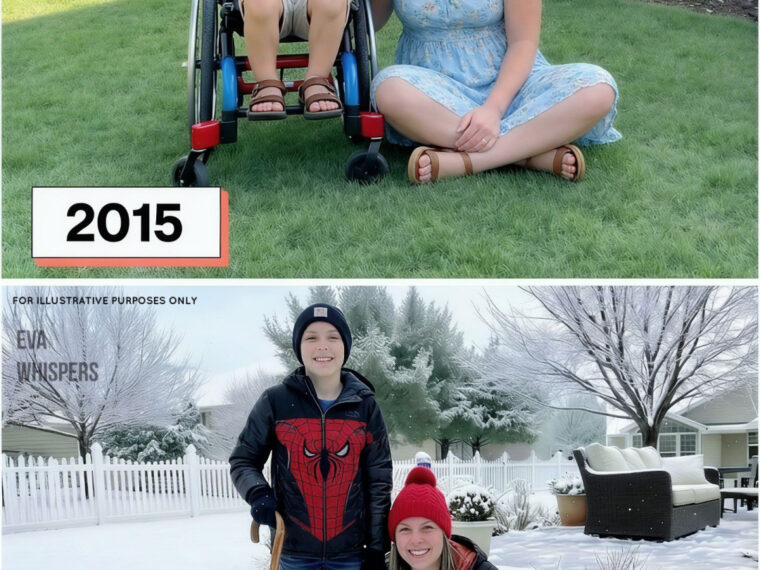
“I CAN’T DO THIS ANYMORE.”
Those were the first words out of my sister Lila’s mouth when I opened my front door that night.
She stood there rigidly, one hand gripping a small suitcase, the other shoved firmly against the back of her four-year-old son, Evan. He nearly lost his balance on his weak legs before instinctively grabbing onto my coat.

Lila wasn’t crying. There were no tears, no shame, no hesitation. Her face was tight with irritation, like she’d just finished an argument she was tired of having.
Before I could even ask what was wrong, she pushed Evan fully into my arms.
“I met someone,” she said bluntly. “He doesn’t want kids.”
I stared at her, my mind scrambling to catch up. “Sorry… what?”
“For God’s sake, Amy,” she snapped. “I deserve a better life. I’m still young. I can’t be trapped forever.”
My eyes dropped to Evan. He was clutching his tiny suitcase, his fingers trembling, his gentle smile still somehow in place. His legs—braced and fragile—were already shaking from standing too long.
“You’re just… leaving him?” I whispered.
Lila exhaled sharply. “You don’t understand. The doctors, the therapy, the money. It never ends. I’m exhausted.”
She lowered her voice, as if that made the next words acceptable.
“Honestly? I hate this boy. I want a normal life.”
Evan stiffened.
Then, as if trying to soften the cruelty, she added, “You’ve always loved him. You’ll do better than me.”
She placed his suitcase on the pavement, turned on her heel, climbed into a waiting car, and slammed the door shut.
The engine started.
And she never looked back.
I stood there frozen, holding Evan while the car disappeared down the street. He buried his face into my coat, his small body shaking.
“Auntie…” he whispered. “Where’s Mommy going?”
I dropped to my knees, even though they felt like they might give out. I wrapped my arms around him, holding him close.
“I’m here,” I said, my voice breaking. “I’m not going anywhere.”
I was twenty-seven years old. Single. Broke. Living in a cramped one-bedroom apartment with mismatched furniture and an unreliable paycheck. Raising a disabled child wasn’t part of any plan I’d ever made.
But Evan needed someone.
And I chose him.
The first years were the hardest.
I learned how to carry him without hurting his hips. I memorized medical terms I’d never wanted to know. I worked two jobs—waitressing during the day, cleaning offices at night—then stayed up studying special education courses online after Evan fell asleep.
Some nights, I cried silently in the bathroom so he wouldn’t hear.
Evan never complained.
When other kids ran past him at the playground, he clapped for them. When strangers stared, he smiled back. When pain twisted his face during therapy, he whispered, “It’s okay, Auntie. I’m brave.”
At seven, he started walking short distances with braces. At nine, he insisted on joining academic competitions “just to try.” At ten, he brought home his first honor certificate.
I cried harder over that piece of paper than I had over any heartbreak in my life.
One night, half asleep, he called me “Mom.”
Then he paused. “I mean… Auntie.”
I didn’t correct him.